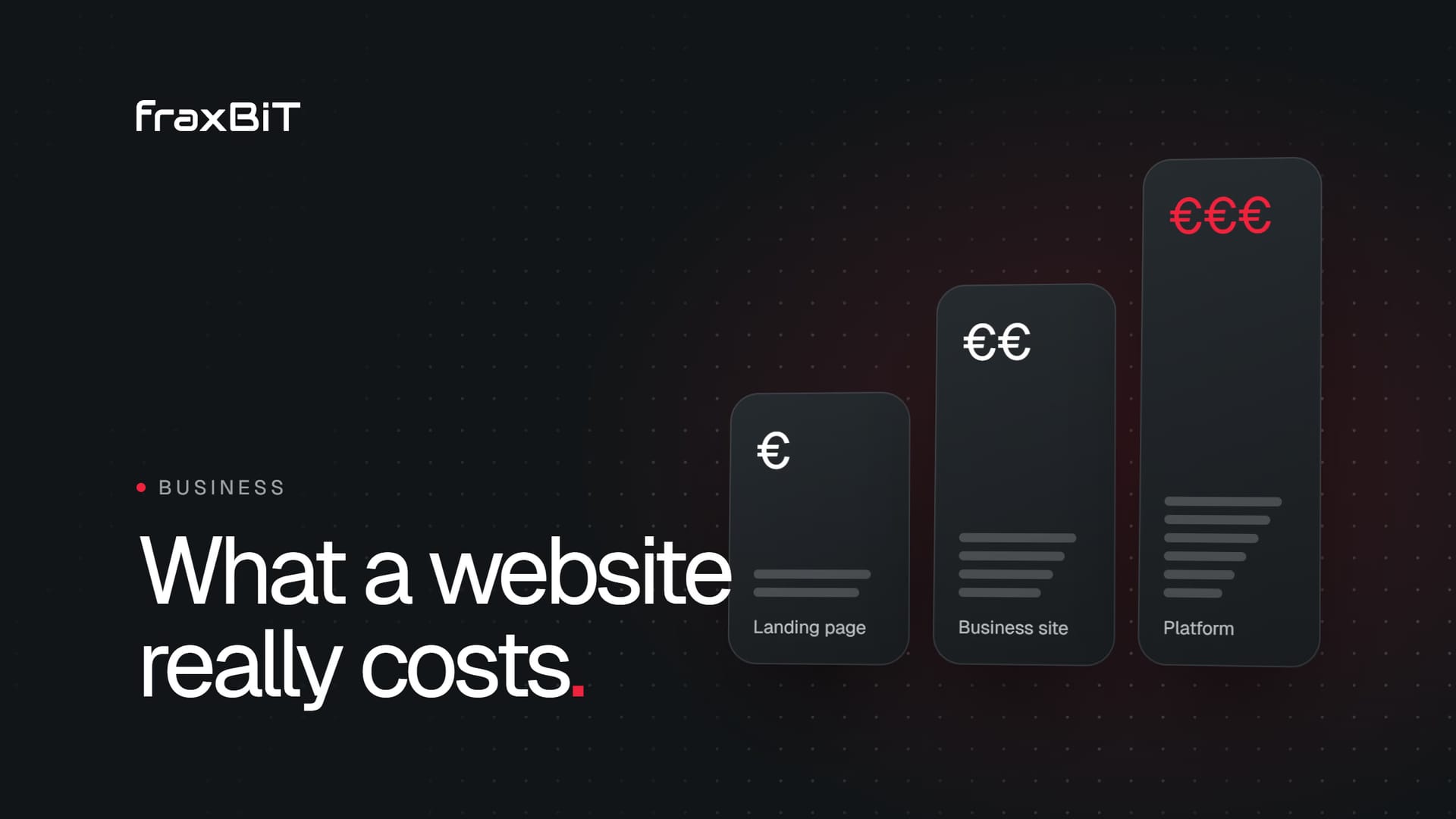
A professional website can cost anything from around a thousand euros for a focused landing page to well into five or six figures for a custom platform or web app. The price is driven by scope, how much of the design is custom, who produces the content, the integrations you need and the work that continues after launch. This guide explains each cost driver, the main tiers, the hidden costs of going cheap and how to compare quotes so you pay for what actually moves your business.
Why website prices vary so much
Two quotes for "a website" can differ by a factor of ten, and both can be fair. That is because "a website" describes very different things:
- A one-page template site with your logo and stock photos
- A custom-designed business website with a clear structure, written copy and SEO groundwork
- A platform with user accounts, bookings, payments or a dashboard
The bigger the gap between quotes, the more likely it is that the providers are pricing different projects. Before you compare numbers, make sure you are comparing the same scope.
What drives the cost of a website
Scope and number of templates
Cost tracks the number of unique page layouts more than the raw page count. Twenty service pages that share one well-designed template cost far less than twenty pages that each need their own layout. Ask yourself which pages truly need to be different: the homepage, a service page, a case study, a contact page, and perhaps a blog article.
Custom design vs template
A template is cheaper up front because the design work is already done. The trade-off is that you look like everyone else using it, and you inherit its structure, its code weight and its limits. A custom web design starts from your audience, your offer and your brand, so every section has a job. It costs more because it involves research, wireframes, visual design and usually a small design system that keeps future pages consistent.
Content: copy, photos and video
Content is the most underestimated line item. Someone has to write clear service descriptions, gather case studies, source or shoot photos and prepare any video. If the agency writes the copy, expect that to be priced separately. If you write it yourself, budget real time for it, because late content is one of the most common reasons projects slip.
Functionality and integrations
Every connection to another system adds work: CRM, booking tools, payment providers, newsletter platforms, ERP or inventory data, multilingual setups and custom forms with logic. Each integration needs to be built, tested and kept working when the other system changes its API.
SEO, speed and accessibility
A site that looks good but loads slowly or is invisible to search engines is an expensive brochure. Solid technical SEO, structured data, fast mobile performance and accessible markup take deliberate effort. Increasingly this also includes making your content easy for AI assistants to understand and cite, which is part of what a growth and SEO service covers.
Maintenance and hosting
After launch you will pay for hosting, domain, possibly premium plugins or SaaS licenses, security updates, backups and ongoing improvements. These are recurring costs, so plan for them from day one.
Typical tiers and what you get
The ranges below are general market observations, not fixed prices. They vary widely by country, team seniority and scope.
| Tier | Typical scope | What it is good for | Rough budget range |
|---|---|---|---|
| Landing page | One focused page, one offer, one call to action | Campaigns, product launches, testing an idea | From around a thousand euros to a few thousand |
| Business website | 5 to 20 pages on a few custom templates, CMS, SEO groundwork, forms | Service businesses, clinics, firms and consultancies that need leads | Often a few thousand to the low five figures |
| Custom platform or web app | User accounts, dashboards, bookings, payments, integrations | Products, marketplaces, internal tools, booking platforms | Usually five figures and up, depending on features |
Landing page
A landing page does one thing well. It works best when you already have traffic, for example from ads, and need a page that converts that traffic. The cost is mostly in the strategy and copy, not the code.
Business website
This is where most companies sit. The budget goes into structure, messaging, custom design, a CMS your team can edit and a solid technical foundation. For regulated or trust-heavy sectors such as healthcare or legal services, extra care goes into credibility signals, compliance details and clear booking paths.
Custom platform or web app
Once the site needs logic, such as user logins, booking calendars, pricing calculators or dashboards, you are building software. Web development at this level involves architecture decisions, data models, testing and security. The cost scales with the number of features and the complexity of the rules behind them, so a phased roadmap often makes more sense than one big launch.
The hidden costs of going cheap
A low quote is tempting. Here is where the savings tend to come back as costs later:
- Rebuilds. A site that cannot grow with you often has to be replaced within a couple of years, which means paying twice.
- Slow performance. Heavy page builders and stacks of plugins can make mobile pages slow, which hurts both rankings and conversions.
- Lost leads. Weak structure and generic copy mean visitors leave without contacting you. You never see that cost on an invoice, but it is usually the largest one.
- Lock-in. Some cheap offers keep the code, hosting or domain in the provider's account. Leaving becomes expensive or impossible.
- Security and maintenance debt. Outdated plugins and no update plan lead to hacks, downtime and emergency fees.
- Your own time. Endless revisions, unclear ownership and missing documentation cost management hours.
How to set a realistic website budget
Start from the value of the outcome, not from a number you heard somewhere.
- Estimate the value of a new customer. What is one client, patient or order worth to you over a year?
- Define the goal. How many extra enquiries or sales per month would make the site clearly worth it?
- List the must-haves. Separate what you need at launch from what can come in phase two.
- Add the running costs. Hosting, licenses, maintenance and content updates for at least the first year.
- Keep a buffer. Set aside a margin for changes you will discover during the project.
Seen this way, a website is an investment with a payback period, not a one-off expense. It also makes conversations with agencies far more productive, because you can discuss what the budget needs to achieve.
How to compare website quotes
Lay the proposals side by side and check the same points in each one:
| Question | Why it matters |
|---|---|
| Is the design custom or based on a template? | Affects how distinctive the site is and how flexible it stays |
| Who writes the content? | Copy is often the biggest gap between quotes |
| How many revision rounds are included? | Prevents surprise fees in the middle of the project |
| What SEO and performance work is included? | Determines whether the site can be found and loads fast |
| Which CMS or stack, and can your team edit it? | Defines your day-to-day effort after launch |
| Who owns the code, design files, domain and accounts? | Protects you from lock-in |
| What happens after launch? | Support, maintenance and improvement terms |
| What is the timeline, and what do they need from you? | Shows whether the plan is realistic |
If one quote is much higher, ask what it includes that the others do not. If one is much lower, ask what it leaves out. Choosing the agency itself is a decision of its own, and our guide on how to choose a web design agency covers the questions to ask before you sign.
What a good website proposal contains
A strong proposal reads like a plan, not a price list. Look for:
- A summary of your goals in their words, showing they listened
- Scope: pages, templates, features and integrations, clearly listed
- Process and phases: discovery, design, development, testing and launch, with what you approve at each step
- Timeline with milestones. For a custom business website, four to eight weeks is a common range once content is ready
- Team: who designs, who builds and who manages the project
- Pricing broken down by phase or deliverable, with payment terms
- What is not included, stated plainly
- Ownership and handover: code, files, accounts and documentation
- After-launch support: what is covered, for how long and at what cost
- Relevant work: examples from similar projects you can review in a portfolio
A vague proposal is a warning sign. If you cannot tell what you are getting, neither can the team doing the work.
Getting the most from your budget
Whatever your budget, the same principles stretch it further:
- Put money into strategy, structure and copy first. They drive results more than visual extras.
- Use one well-designed template system rather than many one-off layouts.
- Launch the core and improve in phases, using real data from visitors.
- Choose a stack your team can manage, and insist on owning everything.
- Treat speed, SEO and accessibility as part of the build, not as add-ons.
Summing up
A professional website costs what its scope requires: a focused landing page, a custom business website and a web app sit in very different budget ranges. Compare quotes on scope, content, SEO, ownership and support rather than on the headline number, and budget from the value a new customer brings you.
If you already have a site and want to know where it stands before you budget for a new one, run the free website audit. It checks SEO, mobile speed and AI search readiness in a few minutes. When you are ready to scope a project, fraxBIT has delivered more than 240 projects for clients in 22 countries, and you can book a call to talk through what your site needs to achieve.
Keep reading
SEO & AI Search8 min read
How to get your business recommended by ChatGPT and AI search
AI assistants search the web live before they recommend a business. Here is how they choose sources and what makes your site easy to find, trust and cite.
Read article
Web Design6 min read
How to choose a web design agency: questions to ask before you sign
The prettiest portfolio is not always the right partner. These are the questions to ask, the red flags to watch for and a simple way to compare proposals.
Read article